Showing posts with label Neuromuscular. Show all posts

Monday, June 1, 2009

The Wolnick Trigger Point Protocol

OK, lame name, I know. I’ll come up with something better soon.

Over the years, I’ve dealt with a lot of trigger points. I just talked about a few of my own in my last post. Now some of these trigger points are just plain nasty. They exhibit the kind of pain that simply wants to make you cry – the “exquisite tenderness” described by Travell & Simons. I’ve seen what’s out there as far as techniques for addressing trigger points and have developed a protocol for deactivating them that has worked very well. Surprisingly enough, I’ve never seen any one source that puts all of these techniques together into a single protocol. If you have, let me know, and I’ll give them credit! This is what I teach my students and use myself. Works like a charm!

Here’s a simple version of my protocol:
  1. MET
  2. Cross-Fiber Friction
  3. Static Compression
In that order!

MET, aka Muscle Energy Technique

MET has to be one of my favorite styles. It has some great advantages, not the least of which that it can address a trigger point without the same kind of excruciating pain as the other techniques. Simply described, MET is a technique that you can use to reset the communication between the brain and the muscle. Often, at least part of the irritation is that the nervous system is maintaining a negative feedback loop that reinforces the dysfunction in the muscle. In my experience, using MET nearly always reduces the irritation of the trigger point before you start using any more painful techniques. This decreases the discomfort of the client, and some trigger points may even disappear entirely without any pain! I love the look of confusion on a client’s face when you do a simple exercise and then their pain has disappeared. They always ask “Are you pressing in the same spot?”

MET involves a thorough knowledge of kinesiology and the ability to apply very slight resistance in precise planes of movement. You establish a clear signal between the brain and the muscle and take advantage of innate reflexes to obtain specific effects. Sounds complicated, and the reasoning behind it is, but in practice it’s fairly simple to actually perform. You can learn more about MET here, a few videos here (1 and 2), and a technical paper here.

Cross-Fiber Friction (CF)

The favored technique of Clair Davies, author of the Trigger Point Workbook, this technique has seen a rise in popularity over the years. While it is still painful to the client, the pain is in short bursts rather than a sustained pressure. This allows the client to tolerate more, but also allows for more of a pumping action in restoring circulation to the area. Davies recommends that only 6-12 good, firm strokes over the trigger point constitutes a treatment – a guideline I agree with. This prevents you from overworking the point and causing the trigger point to go active on you. Ouch.

This technique is one that you can do easily on yourself as well. This is good, since it is better to work frequently and in short bursts on a trigger point than rarely but for a long time. It is something that your clients can do at home. Often, the cross-fiber friction will take care of the trigger point aggravation. If not…

Static (Ischemic) Compression (SC)

Ahh, the good old standby of Neuromuscular Therapy (video here). This technique involves holding sustained pressure directly over the trigger point. This has the effect of increasing the pain sensation and “overloading” the neurological circuit so that it shuts down, kind of like tripping the circuit breaker. The analogy that I like to use is that of a rain bucket. The water in the bucket is the amount of irritability in the trigger point. As it fills, eventually the bucket overflows (the TrP goes active) and starts sending pain elsewhere. SC is like tossing bricks in the bucket. It causes it to overflow, but after you’ve drained some water, when you pull the bricks out there is less water in the bucket.

This is certainly the most uncomfortable of the trigger point techniques – which is precisely why I save it for last. However, there are some trigger points that don’t seem to respond to anything else. The good news is that by the time you get to static compression, the other techniques should have reduced the irritability so that this one isn’t so bad.

To perform this technique, locate the precise point of the pain, sink in to the point until you get to a pain of 7 on a scale of ten (the point where if you go past you’ll need to tense up to resist it), and hold it. If the pain is increasing, release and try something else, if it is staying the same, hold for 8-15 seconds then repeat, if it is decreasing, ride it home until it levels off.

I recommend that you only combine up to 3 treatments of either CF or SC at one time to avoid overworking the point and sending the client home in pain. It is a very common mistake to overwork a point and it is very easy to do.

Happy Trigger Point Hunting!

Wednesday, May 27, 2009

Getting in Touch with Your TFL

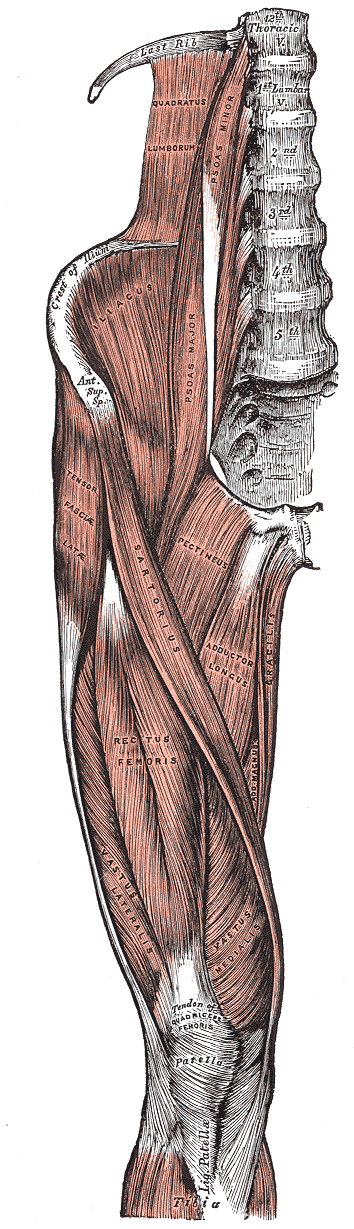
Your Tensor Fasciae Latae (pronounced Tensor Fah-sha Lotta), or TFL, is a small, upside-down teardrop-shaped muscle in your hip. While the muscle isn’t large, it certainly has a large role in how your hips function. You can see a picture here from Gray’s Anatomy and some interactive anatomy here. The TFL helps to abduct, flex, and medially rotate your hip as well as extend your knee (or prevent it from collapsing while walking). Of course it helps to regulate the opposite of those actions too. In short, TFL is involved in every motion of the hip and the major actions of the knee! The insertion for this important little muscle is on the Iliotibial Band (ITB), that taut strip of connective tissue going down the outside of your thigh. TFL can be responsible for some considerable tenderness and tightness on the outside of the thigh.

My Connection

I think it’s funny that I teach this stuff, and I pass it along to my client’s all the time about what is good for them, and yet I have problems with my own TFLs. I had reconstructive surgery on my ACL 12 years ago and I have to say that my hips and legs haven’t been the same since. Over time, I have slowly realized that it’s not so much the surgery as how my body responded to the surgery – and the protective mechanisms I developed. Don’t ask me why it took me so long to realize this; I guess it’s easier to look objectively at somebody else’s body.

How it manifests for me is a massive trigger point in my left TFL. It’s bothered me on and off over the years – some little stress sets it off and it will make my entire leg ache. Over the past few years however, I’ve found a new pattern of periodically tweaking my hip when I carry something awkward (like a massage table) on one shoulder. Invariably it causes my left piriformis to go into spasm so that I can hardly walk – limping for several days. Only just recently have I realized a direct connection between the two pains. I have the same problems mirrored on my right side, just not as severely.

Lifting something awkwardly for a Memorial Day picnic, my piriformis went into spasm again. In working on the area myself, I probed around the rest of my hip to try to see what else was contributing. When I pressed on the latent trigger point in my TFL, my piriformis began pulsating for as long as I help the pressure. When I dug in a little further, I felt a sharp pain in the middle of my anterior shin (Tibialis Anterior) – another common site of pain for me. AHA! Paradigm shift!

Bodywork

IN my next post, I’ll go into a little more detail over the treatment protocols I intend to use to get rid of these things. I’m a massage teacher, and I can receive bodywork on a fairly regular basis. Still, I’ve been receiving bodywork regularly for years and it hasn’t done much for these trigger points. Nothing short of direct, focused efforts will do it. So here’s my plan.

First, I will make sure that I get at least one massage per week with at least some special emphasis specifically on my hips and these trigger points. Good, but that won’t be enough. Clair Davies recommends that you work on them with 6-12 good strokes multiple times per day and that you’ll see improvement in less than 2 weeks, even for the really bad ones. Well it’s proving time! I’m going to work them at least three times per day for at least two weeks and gauge the results.

I’ll keep you posted!

Tuesday, October 28, 2008

More Thoughts on Muscle Energy Technique

In the latest (Nov/Dec 2008) issue of Massage & Bodywork Magazine, there is an article entitled “Sports Injuries: Breakthrough Methods in Treatment” by Karta Purkh Singh Khalsa. There is a lot of great information in this article, but something strikingly lacking is the use of MET (Muscle Energy Technique) in treating these injuries. I can see great value in the manual techniques that Mr. Khalsa describes, but have to argue that those should come after MET has been employed.

As my work has grown, I have moved away from a purely manual approach – in the sense that I used to do it all myself. Teamwork is key, and in this case your teammate is your client; more specifically, their brain. If their brain is holding tension or inhibiting a muscle, it can take quite a bit of work to get it to normalize, and often the effects are short-lived. You can be much more successful when you engage the client from within, instead of simply inflicting
a fix upon them.

In addition, MET reduces the irritability of the tissue so that the subsequent work is less uncomfortable. And it creates conditions in which I don’t have to work so hard. I prefer to work from the inside out on a client instead of the outside in.

There is no “I” in TEAM, but there is “A MET”!

This also helps to start the process of rebalancing the joint. Sherrington’s Law of the Reciprocal Inhibition of Muscles…

“When one set of muscles is stimulated (our agonist, or target muscle), muscles opposing the action of the first (antagonists) are simultaneously inhibited.”

…is important to understand. Many novice therapists make the mistake of only working the sore muscles. Often the soreness is caused by excess eccentric load caused by hypertonic muscles on the other side of the joint. In simple terms, they are sore because they are exhausted from resisting the tension of the opposing muscles. They are also weak (inhibited) because of the hypertonicity of their antagonists. Relax that tension and the load on the sore muscles is decreased. MET is great because that is exactly how it works – by balancing the muscles on both sides of the joint.

Incidentally, MET improves the communication between the brain and the muscles and clears dysfunctions such as the negative feedback loop created by a trigger point (TrP). I always use MET to reduce TrP activity prior to more aggressive and painful techniques such as cross-fiber friction or sustained (ischemic) compression. Sometimes MET alone is enough all by itself, but even when it isn’t, almost every time the irritability is reduced so that the other techniques cause much less discomfort to the client.

Yet another effect is that MET retrains the brain as to what the state of the tissue is and how it should be. It allows the brain to do a reset of the proprioceptors. Ultimately, it will be the new and healthier movement patterns that allow the work to endure.

So I will close with the immortal words of Snoopy.

“Get MET, it pays!”

Muscle Memory

We’ve all heard somewhere along the line that muscles have memory. So do they? Yes and no. What does that really mean?

The Muscles Themselves

Muscles themselves only have a little “memory”. Myofascia is designed for movement, and it molds itself to the stress that it experiences. In that capacity, if the myofascia has been shaped by habitual movement, the muscles will only be used to, or even able, to move within that range. So in that sense, muscles do have a memory.

The Bigger Picture

More to the point, it has more to do with the nervous system’s relation to the muscles. When the nervous system generates an impulse, neurons talk to each other – a line of communication is opened, potentially where none existed before. But once that line of communication is established, every time those neurons speak to each other it reinforces the connection. Of course this is why practice makes perfect – every time we do a particular action, our brain gets better and better at coordinating the muscles to do it. incidentally, when we start resistance training, the initial gains in strength are more due to improved communication between the brain and the muscle than any physical increases in the muscle itself.

This is what we’re really talking about when we say muscle memory – these habitual patterns of movement. When we learn how to do something a particular way, it can become very hard to undo it. For instance, you know how you can identify many people by the sound of their footsteps? This is because when we learn to walk we develop a unique gait. It takes over a hundred muscles working in coordination to walk and we all learn how to do it in a slightly different way. These patterns become ingrained and the connected neurons prefer the familiar. This is also why we massage instructors harp on our students to use proper body mechanics all the time – if you start by learning it the wrong way, it will be much harder for you to learn it the right way.

These connections, once learned, go on autopilot. And a good thing too. Who would want to have to constantly think about putting one foot in front of the other, or the position of your tongue while you are speaking? But once they become unconscious, we also lose some awareness about what we are doing. This is fine if things are working the way that they should, but when things are off we need to bring the awareness back.

When we get injured, we can develop bad habits, maybe habits that were necessary while we were hurt (limping), but no longer serve a purpose once we’re better (continuing to limp after healing). Our bodies adapt wonderfully to remain functional in response to these things. But once your body has found a way it likes to do things it can be hard to get it to go back to do it the right way, the optimal way.

Can it be done? Of course, but it may not be easy. Stroke victims can relearn to do things that they lost because of the neurons that knew how to do it dying. It is a matter of re-patterning.

So What Does This Mean?

For our clients, this means we need to understand how these patterns affect them. What factors were in place when developing these movement patterns? Did they break their leg as a child, or have something disrupt their development? Was there an injury? Athletic training? How long has it been there? The old saying that you can’t teach an old dog new tricks is somewhat valid – It’s a lot harder to break a habit that has been there a long time because to break a habit, you are really creating a new one to replace it.

Progress will be slow with long-term patterns. I have found that often, clients will feel some relief after massage, but it is short lived. This is because although massage is great, once they leave my office their old patterns begin to dominate again. I always tell my students that even if they come and see me once a week, there are 168 hours in a week – leaving 167 hours for them to undo everything that we worked on in that session. It is vital to educate your clients about what they need to change and think about in between sessions to let the work take hold.

Another implication is that as much as we work on the soft-tissue, it will have little to no long-term effect if we don’t address the neurological functions that maintain the pattern. It’s akin to eating one healthy, nutritious meal (your massage) amidst a sea of junk food (their bad habits). It won’t have much of a lasting effect. It is a process, and one that the client must be on board for. They won’t change until they are willing and ready to.

Reboot

I love Muscle Energy Techniques (MET), PNF (Proprioceptive Neuromuscular Facilitation), and Neuromuscular Therapy (NMT). I will focus on MET here, but use a variety of NMT techniques. They are all techniques that reboot the system by resetting the lines of communication. MET uses the higher thinking of the conscious brain to reprogram the lower order unconscious functions.

In every case you come across, resetting the interface between the brain and the muscles will make your job easier. You recruit the most powerful force in your client’s body, their brain, as an ally. If you neglect to address the neurological dysfunction, those old habits will be actively working against you. Most often this also clears the way to reveal the problems as well. MET will reduce hypertonicity (excess tension in the muscles) so the knots really stand out in the tissue.

Re-educate

Once you’ve done your part as a massage therapist, then you have to recruit the client to do their part. Do your best every session to give them something to go home with that they can do to take some ownership of their healing. An exercise, a stretch, a new movement pattern, a breathing exercise, or just some homework to take note of their posture once or twice a day. These things will help to begin the process of creating new movement patterns. Awareness is key.